Friday, February 25, 2011

Review: The Complete Sherlock Holmes, Volume 2

Author: Sir Arthur Conan Doyle
Genre: Fiction/Mystery
Pages: 871
Warnings: Some Racism, Sexism, Murder and Kidnapping
Rating: 3.5/5

Contains:
The Return of Sherlock Holmes
The Valley of Fear
His Last Bow
The Case Book of Sherlock Holmes

I suppose I started reading this collection for the same reason I watch regular TV shows every week. I wanted consistently interesting short stories, and that's exactly what I got. However I made a mistake reading them all straight through in this convenient collection, and the formulaic plots bothered me more than they would have otherwise.

One thing I cannot get over, and I think the whole Sherlock collection looses points for, is the lack of humor. There is just no comic relief in these tales, which made them difficult to read one after the other. I don't think this would have bothered me as much if I'd had another book to alternate between, but I was in a bit of a dry spell, literature-wise. Some might argue Sir Doyle attempts humor in those scenes where Holmes asks Watson what he thinks about such-and-such then corrects him, and the reader is supposed to laugh at the doctor's thick-headedness, but I just felt bad for him. Watson is a dear character, and when you that remember from the reader's point of view (based on the evidence the reader has) his guess is just as likely to be true as Holmes', the whole joke seems very mean-spirited.

I mentioned it in my review of Volume 1, and I will only bring it up briefly, but Sir Doyle's portrayal of minority characters (anyone not white, land-owning, and male) leaves a lot to be desired. If he can't write non-priveledge bodies as being anything but a stereotype, I'd rather he didn't write them at all. Less briefly: it bothers me even more after reading "The Case of the Three Students", where the Indian student is treated by Holmes exactly like the two other (rich, british, white) students in the context of the story, which proves Sir Doyle could have written much more humanistic characters.

I did notice an improvement in terms of the mystery complexity, which I appreciated. No where is this more evident than in "The Valley of Fear", which uses an extremely similar set-up to "A Study in Scarlet". Both stories have two parts, the first of which takes place in 1890's England and the second some years previous in America. However everything else about "The Valley of Fear" is a vast improvement! The murder mystery is much more clever, the action is better paced, and the second part was well-introduced as well as being a mystery story in it's own right! Clearly Sir. Doyle had come into his own as an author by this point, and his skills greatly improved with practice.

I also enjoyed the change in Watson's "voice" over time. Sir Doyle seems much more comfortable in his writing abilities by "The Valley of Fear", and I felt there was less awkward prose. I noticed Sir Doyle has a very fanciful way of describing the scene, which appeals to me greatly. I shall always imagine a foggy London day as John Watson saw it.

Tuesday, February 22, 2011

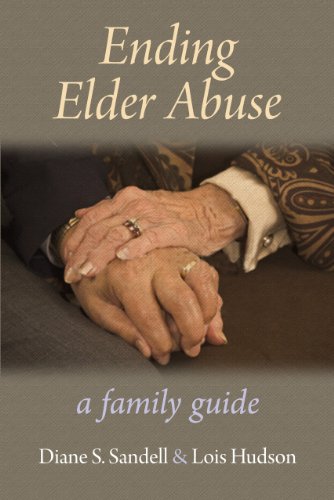
Review: Ending Elder Abuse, A Family Guide

Authors: Diane S. Sandell and Lois Hudson
Genre: Nonfiction
Pages: 144
Warnings: Descriptions and images of Abuse
Rating: 2/5

There is so much valuable information contained in this book! I wish it had been presented in a way that didn't take away from the content. Despite the title "a family guide", this book seems to have at least two additional goals. The book starts by telling the story of Ms. Sandell's personal experience with elder abuse, which is obviously not a guide, but does make the reader aware of the horrors of elder abuse. Mingled in the family guide are encouragements to lawmakers and CEO's to take elder abuse seriously, and consider creating grass-roots groups that would be able to enact change. Instead of being a family guide this book opens with a personal testimony and combines family-specific advise with advocacy advice, and this lack of clarity left me without any clear guidance.

I have no problem with Ms. Sandell's personal testimony, because the story itself was heartbreaking, and it encourages readers to use the data in the guide portion of the book. Ms. Sandell relates how she placed her mother, Bessie Jarvis, in a nursing home nearby. One day an orderly called her to say her mother was injured. When Ms. Sandell arrived her mother was covered with bruises, including a hand-print on her face. No one had reported this incident, and she was told by the facility that sometimes the elderly bruise easily. No one wanted to accept or admit what happened to her mother. It was terrible to read, especially when I imagined something like that happening to my loved ones. However Ms. Sandell refused to let things lie, and she discovered a network of people who were working to stop elder abuse, in all its forms. She went on to affect legislation in her home state of California, and continues to this day to participate in community outreach programs. 

The next few chapters are a jumbled mass of suggestions, advise, resources and coping mechanisms, in a haphazard and disconnected order. I believe the remaining chapters are meant to function has a comprehensive personal guide for caretakers when their elders can no longer live alone. However the formating in these chapters is variable, and the content is not organized. I feel the later chapters in this book could benefit greatly from rewriting. 

All together, this book was only a partial success. The first few chapters made me aware of elder abuse as a systematic and absolutely awful tragedy. They also left me with an urge to do something to affect positive change in this dire situation. However, the "guide" portion of this book was highly confusing, and left me with no clear idea about what I could do. There was some very useful advice for how to assess long-term facilities, but they were hidden in the back of the appendix!

Sunday, January 23, 2011

Review: Talyn

Author: Holly Lisle
Genre: Fiction/Fantasy
Pages: 592
Warnings: References of forced sterilization, violent sex and rape
Rating: 4.5/5

By no accounts was this book perfect, but I'm willing to forgive a book a lot more if it makes me laugh. Right from the start the main character, Talyn, has a fantastic sense of humor that would have kept me interested in a much worse book. Talyn is a character I think most people can empathize with. She's straightforward, proud, and vivacious. Right from the first chapter I cared a lot for her, and I was emotionally invested in what happened to her.

Luckily, Talyn the book is a reasonably good piece of work, so there was very little to forgive. The plot is not at all what the first chapter leads you to expect, a routine war story. It's got fighting mind you, but that's not the book's strong point. In fact, it's for the best that the main focus of the storytelling it's a war, because the scenes which contained actual battles were a little lopsided. Instead Talyn's story takes you down a completely different track than a typical high fantasy war story, and I think it's all the better for it.

My biggest complaint with this book would have to be the ending. In fact, the last few chapters all feel a little haphazard, but the wrap-up was especially lousy. In Lisle's defense endings are the hardest part of a book for most authors, though. Still, I was disappointed by the sudden drop-off in quality.

Something that readers absolutely must be warned about is that this book doesn't shy away from sex. I find this to be a major plus, because I enjoy sexually liberated characters and raunchy jokes. Sex is by no means a major focus of this book, nor are the sex scenes terribly graphic. I just feel that if you're uninterested or unprepared to read about Lisle's forthright portrayal of sexual relationships, you might want to skip those portions of the book. Unless sex between a man and a woman, specifically rough sex, makes you very uncomfortable there is no reason to avoid this book!

The world Lisle creates is very interesting, specifically the conflict between the two nations in conflict, the Tonk Federation and the Eastil Kingdom. The entire book is spend in the Federation, a loose collection of city states united by their ethnicity (Tonk). Lisle favors the Tonks, which I don't mind terribly, because it's so rare for a egalitarian, chiefly society to be portrayed in as much detail in fantasy books. Usually the main culture is a kingdom (or kingdoms) and chiefdoms are on the fringes.  The Tonk/Eastil magic system is equally unusual. The change in pace is refreshing.

There are a lot of good technical points in this book's favor, but I like it so much because it made me laugh, over and over again. 

Saturday, January 15, 2011

Review: The Complete Sherlock Holmes, Volume 1

Author: Sir Arthur Conan Doyle
Genre: Fiction/Mystery
Pages: 752
Warnings: Racism, Sexism, Murder
Rating: 4/5

A delight to read! I suppose there are a reason some books become classics, and after reading it I can certainly see why the adventures of  Sherlock Holmes are one such thing.

Each short story is formulated in pretty much the same way, and with similar levels of quality. It's nice knowing going from one short story to another you can except them to all be equally good, which is why most people read  books by the same author. However since the stories are so short, the best advice I can offer is not to read one right after another, since they get very predictable. In fact, the reminded me of a TV series, which makes sense as the stories were originally published in a periodical magazine.

It was entertaining to be following Holme's train of thought, and try to guess what is happening. For that reason, I preferred his longer stories ("The Hounds of Baskerville", "The Sign of Four" and "A Study of Scarlet"), because these stories where more than simple whodunits.

"The Hounds of Baskerville", unsurprisingly, is my favorite. "A Study in Scarlet" is the first of Sir Arthur Conan Doyle's early Sherlock Holmes stories, and it's clear he doesn't have the pacing perfect yet. I was pretty confused when we jumped to Utah after the first part, and I was seriously concerned Doyle was never going to explain the motives of our killer. "The Sign of Four" seemed a pretty specific story to give Watson a wife, and the obvious premise make the whole story a little cheap, as well as the rather. However "The Hounds of Baskerville" happened after several of the shorter stories (a personal favorite of those being "The Adventure of the Red-Headed League"), and Doyle appears to have matured a bit as a writer by that point (published in 1902, with "A Study in Scarlet" being published in 1887) and the story required the reader to know next to nothing outside the context of the story.

The only hitch was when stories required current political context, because as I am not deeply aware of the politics of 1880's London, I have no idea about some of the assumptions characters make about royalty. Amusingly enough, I didn't have as much trouble with "The Five Orange Pips", because as an American I already knew about the KKK. However this was a problem that Doyle phased out during his early works, and most stories after that explained any 'outside' knowledge that was required. 

I have the sneaking suspicion that Doyle married off Watson in his second novel because Watson and Holmes are clearly one of the cutest bromances ever. Know that I'm not trying to denigrate the series by associating it with the immature antics of two men who clearly never grew their asses up (ex: Pineapple Express), but I'm trying to convey that Watson and Holmes were obviously very close, good friends. It's a really wonderful friendship, and it was a delight to read about two men who loved each other so dearly. I think Watson was married off to make so there was no suspicion of sexual tension between the two main characters, which is probably the result of the homophobic times, but doesn't make them any less good friends. 

Regarding other social contexts that made me squeamish about reading, Doyle's characters are probably less racist and sexist that most people in their time period. Holmes hates women and says they are incapable of keeping a secret (while only some men are) clearly evidencing some solid sexism, and Watson decides to ignore these displays of sexism, meaning he doesn't agree, but he likes his friend too much to disagree about women being less trustworthy. There is a lot of casual racism in the way non-white characters are portrayed, but they're rarely every characters. A notable exception is the description of a South American native in "The Sign of Four", which is pretty awful, and I don't wish to repeat here. More often than not characters who are not white males are actually mentioned in the story, which is frankly a relief. If this is not something you can tolerate, I understand, and I encourage you not to read these stories.

However, if you can look past some of these things, I think this series is worth a read, and as public domain, it's certainly easy to find on the internet, and free. Wikipedia has links to the original book "The Adventures of Sherlock Holmes", and several short stories here. In addition, Project Gutenberg provides public domain stories here.

Monday, January 10, 2011

Review: Tracato

Author: Joel Shepherd
Series: 3/4 in the Trial of Blood and Steel
Genre: Fantasy/Fiction
Pages: 347

Warnings: Torture, Death, Sex, War?
Rating: 3/5


Finally, something happens! The war that I've been expecting since the first book, Lenayin's invasion of the Saalshen Bachosh, has finally started! I feel like it certainly took long enough. On that note, one thing I noticed is that this book, unlike the previous two in the series, jumps right into the action. There is very little time spent on new character development, which seems fair. We already know all the main characters pretty well at this point.

Towards the beginning Sasha and Alythia arrive in Tracato (surprise surprise) at the beginning of the book, at we jump right into some complicated political turmoil in the city. For the first time, the concept of leadership that isn't hereditary is introduced to the reader, and thus there are actual political factions that aren't nobles of some kind. I think Shepherd has some entertaining commentary on rabid politics when he created the Civic Stein, an analogue of a Labor Party, who have a very legitimate beef regarding land ownership. Not without cause, he presents a world were politics is just has belief-laden as religion, which I completely agree with. It's why you're not supposed to talk politics or religion unless you want to fight.

In addition, Tracato has an Ulenshaal, the analogue to a University. I wouldn't really mind if Shepherd just used the same names we used, spelling of imaginary works is not my strong suit. Besides, I've always been suspicious that the more made up words a book has, the less likely it is to be good.

At this point there are several factions in Tracato: the Civic Stein and their many systematizers in Ulenshaal, the Tracato Officials the Judiciars and Blackboots (Judges and City Police), and the feudalists which are largely made up of formal noble families. Into all this mess steps Rhillian, who does pretty much the same thing she did in Petrodor: cause major upheaval and chaos, during which Sasha gets captured by one of the masses (Civic Stein in particular).

In addition, there is lots of military action all happening at once: the Rhodaan Steel, which are the Rhodaan nation's army (of which Tracato is a part), attack and conquer Elise, a neighboring nation, during the first half of the book. After which there is a bit of civil unrest in Tractao, and the Blackboot squelch this. During the final portion of the book the Lenayin army chills in Larosa while Sofy gets hitched, then travels to conquer Enora, the second nation of the Saalshen Bacosh that will have to be defeated, and the site of the most holy Verathane temple and the impetus of the entire war. Clearly, a lot of plot went and happened.

The pace of the first two books in the Trial of Blood and Steel was pretty forumlatic. The first half or so of the book was spent learning about the characters and building up to some sort of battle scenes that only pertained to the book, not the series. I felt Tracato completely skipped the introductions and started instead at the first set of book-specific battle scenes, in this case being the Tracato civil war. Then it jumped to the series-wide conflict, the Toravan/Lenayin invasion of Enora. I was personally pleased to see this focus on action and moving forward the overall plot of the series, and I preferred the way character development was strewn throughout the book. It felt much more realistic, and I didn't feel like I had to fulfill some sort of characterization quota (which is saying something, because I love Sasha). It just... felt a little better paced to me. I look forward to the finale! (it is the finale, right?)